Real exam-length tests, authentic topics, and AI-driven feedback on your speaking and writing. For every subscriber, we fund a free account for a refugee preparing for certification.
No payment needed to start


Our mission
DiscussEarth is more than a test-prep platform. Our core mission is to give refugees and displaced people the English skills they need to study, work, and resettle — by funding one free account for every paying subscription. Learn more about our mission →
We're working to partner with refugee organizations to identify and support the learners who need this most.
Sponsored accounts get the same full access as paying subscribers — no watermarks, no limited tests.
Where we're at
We're early. Here's what's real today, and what we're tracking as we grow.
Community
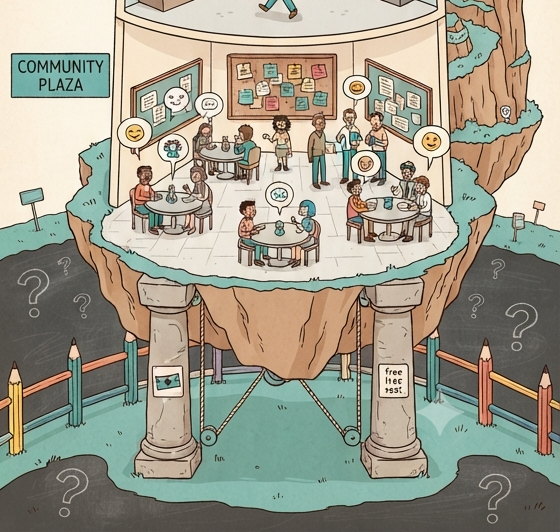
A shared topic bank ties tests and discussion together, so you read, write, and speak about the same real-world ideas.
The role of agriculture in global food security.
Weekly topicBuilding a clear thesis statement and logical flow in IELTS essays.
Study groupStories of resilience and adapting to a new academic environment.
Community hubHow technology is bridging the gap for learners in remote areas.
DiscussionGetting started
Create your free account. Refugees and displaced learners can apply for a sponsored seat during this step.
Take a real IELTS test and get AI feedback on your strengths and weaknesses.
Practice with other learners in the community hub, using the same topics as your tests.
Testimonials
Testimonial coming soon.
Sign up free and take a full four-skill diagnostic test to see where you stand.
Get started freeGood afternoon
Maria
Free sample
Reading + Writing, Test 1
Your free sample result
5.5
Reading band
6.0
Writing band
Review your answers
Reading, test 1
Writing, test 1
Today's topic
CommunityCoral reef bleaching: should governments fund restoration?
You've used your free sample
Unlock all 20+ tests across reading, listening, writing and speaking — plus community and AI speaking practice.
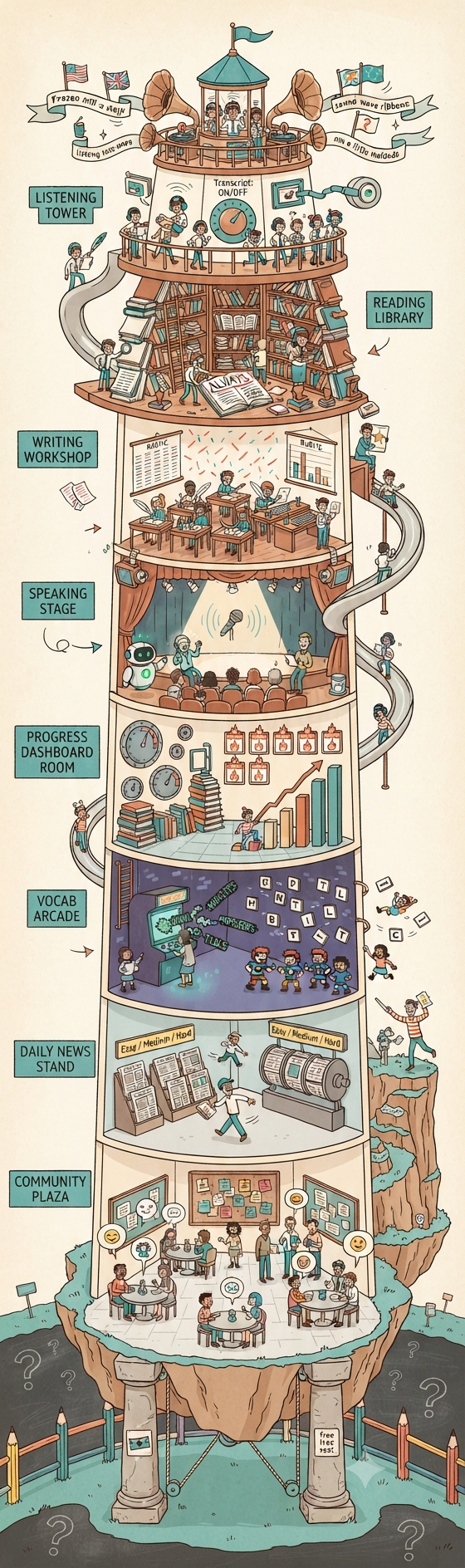
Practice the full IELTS & TOEFL catalogue across all four skills.
Showing tests · Subscribe to unlock all
In 1924, representatives of the world's leading lightbulb manufacturers convened in Geneva to address what they saw as a troubling commercial problem: their products lasted too long. Bulbs that endured for 2,500 hours or more were, from a revenue standpoint, an obstacle to sustained profit.
The resulting agreement, known as the Phoebus cartel, established a maximum bulb lifespan of 1,000 hours. Manufacturers that exceeded this limit faced financial penalties, while those producing shorter-lived bulbs were rewarded. The cartel coordinated production across borders, dividing global markets and setting technical standards that ensured conformity.
Economists have since debated whether such coordinated lifespan reduction constitutes a net harm to consumers or a rational response to market incentives. The case against is straightforward: consumers paid more over time, replacing bulbs that could have lasted longer. The case for is more subtle: shorter product cycles may have accelerated innovation, driving down costs and expanding access to electric lighting more broadly.
The Phoebus cartel dissolved by the early 1940s, partly due to wartime disruption and partly due to antitrust pressure in the United States. Yet its legacy persists in the economic concept of planned obsolescence — the deliberate design of products to require replacement — which critics argue remains embedded in manufacturing culture to this day.
Contemporary examples are not difficult to find. Smartphone manufacturers have faced regulatory scrutiny for software updates that slow older devices. Printer companies have been accused of programming cartridges to report as empty before they are depleted. In the European Union, right-to-repair legislation introduced in 2024 represents a direct legislative response to what regulators characterise as a systemic pattern.
Questions 14–18
Do the following statements agree with the information given in the passage? Write TRUE, FALSE, or NOT GIVEN.
14. The Phoebus cartel set a minimum, not maximum, bulb lifespan.
15. Manufacturers exceeding the lifespan limit were financially penalised.
16. Economists agree the cartel was illegal under Swiss law.
Questions 19–20
Complete the sentences. Write ONE WORD OR NUMBER only.
19. The cartel's meeting was held in .
20. Bulbs were limited to a maximum of hours.
Your IELTS practice history and band score trends.
Update your study profile and account preferences.
Band score
5.5
Modest user
Correct answers
27/40
67.5%
Time taken
54 min
6 min remaining
Vote on next week's topic. Discuss this week's.
Vote for next week's topic
All plans include a free test to try before you subscribe. Cancel any time.
Every subscription funds a free seat
For every paying subscriber, DiscussEarth sponsors one free account for a refugee or displaced person preparing for English certification.
Which exam are you preparing for?
Save up to 17% — pay quarterly instead of monthly
IELTS · Basic
$4.99/mo
All tests, AI feedback, progress tracking
IELTS · Premium
$7.99/mo
Everything in Basic, plus a live AI speaking tutor
Schools & institutions
DiscussEarth offers group licensing for universities, language schools, and test-prep centres. Provision your students in bulk, track progress across your cohort, and pay a single invoice — no individual sign-ups required.
Need something built for your institution?
DiscussEarth also works with schools to design and build custom English programs — placement tests, writing assignments, speaking rubrics, and grading tools — tailored to your curriculum and students.
Get in touch to explore what that might look like for you.
Start a conversation →Already have an account? Sign in · Questions? Contact us
For millions of refugees and displaced people, an IELTS or TOEFL certificate is the key to a university place, a job, or a new country. But quality preparation is expensive, and largely out of reach for those who need it most.
The founder
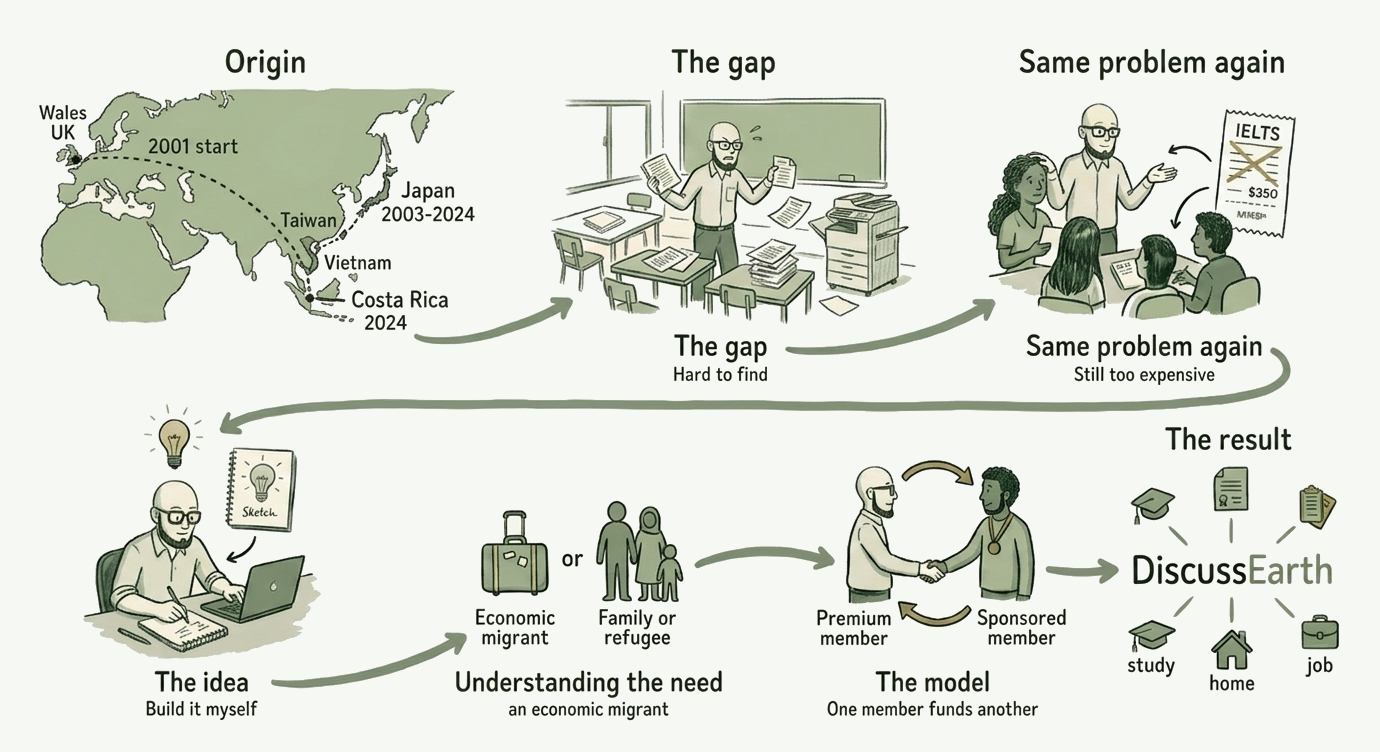
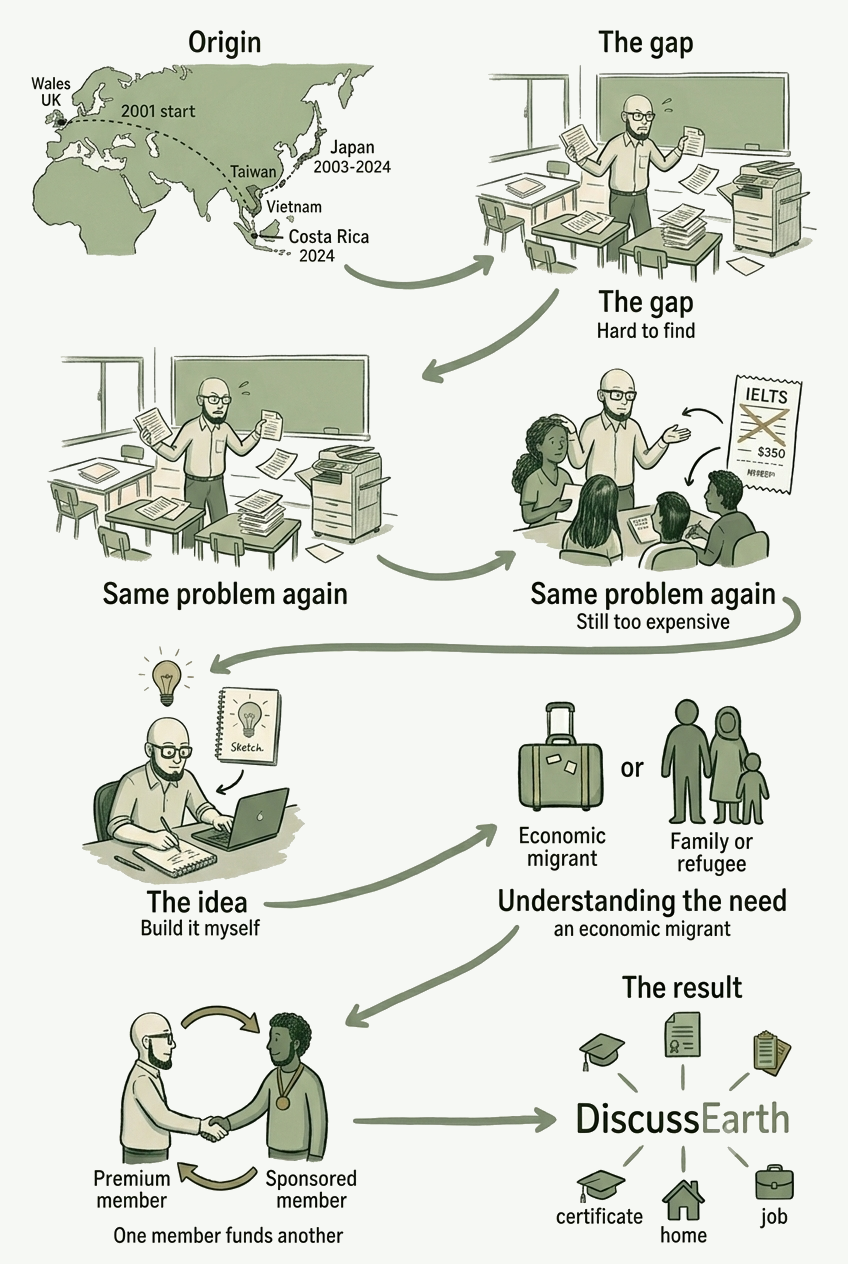
Simon Whalley is from Wales, in the UK. He has been teaching English since 2001, starting in Taiwan, then Vietnam, then Japan, where he stayed for over two decades before moving to Costa Rica in 2024.
While teaching in Japan, Simon noticed a gap. Quality materials for test preparation were hard to find, so he found himself photocopying and making do, piecing together resources from wherever he could. Even as an experienced, qualified teacher, he struggled to find good materials for his own students.
After moving to Costa Rica and working with students preparing for the IELTS, he ran into the same problem again. What options existed were expensive, and still not quite what his students needed. So he decided to build something himself, and to keep it affordable for everyone.
Simon is an economic migrant himself. He understands that people moving to a new country need to learn the language, but they don't always have the money for expensive materials and resources. That struggle led to a harder question:
If an experienced teacher was finding it this difficult, what must refugees and displaced people be facing, without his training or his resources?
That question is where DiscussEarth came from. Simon didn't just want to build something cheap. He wanted every paying subscriber to directly fund a free account for someone who couldn't pay at all, through partnerships with refugee settlement organisations. Sponsored accounts get the same full access as Premium subscribers. No watermarks, no limited tests, no second-class experience.
It matters because IELTS and TOEFL prep courses can cost hundreds of dollars. For someone who has lost their home, their career, and in many cases their community, that barrier is insurmountable. Building DiscussEarth this way means the same preparation is available to everyone, and every paying student knows their subscription is doing more than buying access to tests.
What DiscussEarth is
Want to partner with us?
If you work with refugees or displaced communities and want to explore sponsored access, we'd love to hear from you.
We're here to help you on your IELTS and TOEFL journey.
Questions about your account, a test, pricing, or anything else.
If you work with refugees or displaced communities and want to explore sponsored access for your students, we'd love to talk.
Frequently asked questions